WHAT PROJECTS COST
Transparent investment ranges for design-build projects in Oakland County, Michigan.
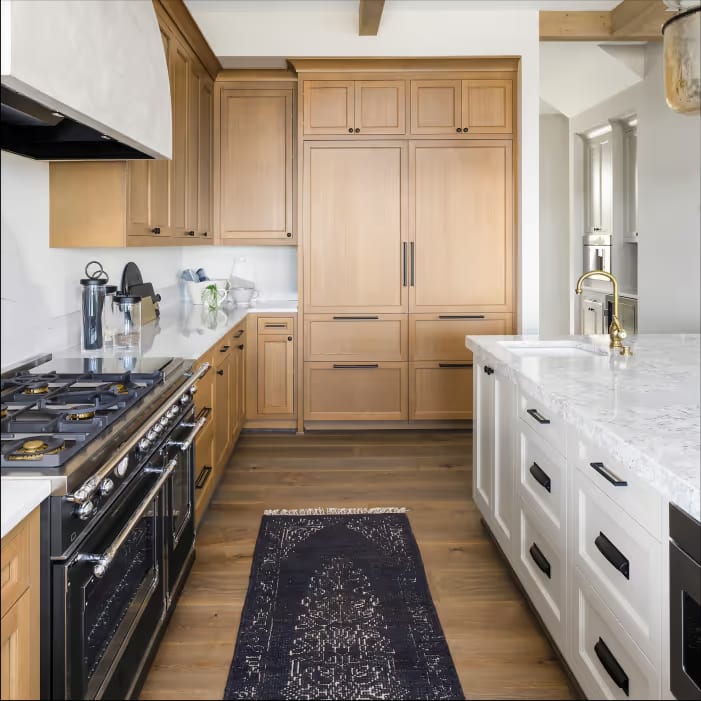
Main-floor remodels in Oakland County typically start at $120,000 and range to $400,000+ depending on layout complexity, structural changes, and finish level. Custom homes start at $700,000. Commercial tenant improvements range from $50 to $250 per square foot. These ranges reflect 2026 Oakland County market conditions.
Main-Floor Remodel Investment Ranges
Main-floor remodels are our core service. These projects go beyond a single-room update, reworking how the kitchen, dining, and living areas connect and function together. Investment depends on how much of the main floor is involved, whether structural changes are needed, and the finish direction.
| Scope | Typical Range | What's Included |
|---|---|---|
| Kitchen-Focused Remodel | $120,000 – $200,000 | Full kitchen rebuild with cabinetry, countertops, appliances, flooring, lighting, and finish coordination. May include minor layout adjustments and adjacent hallway or entry updates. |
| Kitchen + Adjacent Rooms | $180,000 – $300,000 | Kitchen remodel plus dining area, living room, and circulation improvements. Often involves wall openings, structural coordination, and integrated flooring and finish planning across connected spaces. |
| Full Main-Floor with Addition | $250,000 – $400,000+ | Comprehensive main-floor transformation including a bump-out or addition. Structural engineering, foundation work, zoning coordination, and full mechanical integration across the expanded footprint. |
What drives cost higher: Structural beam work, load-bearing wall removals, premium cabinetry and countertop selections, mechanical system relocations, and additions that require foundation and roofline work.
Custom Home Investment Ranges
Custom home investment varies significantly based on size, site complexity, architectural design, and finish level. The ranges below reflect 2026 Oakland County construction costs for design-build delivery where scope is fully defined before breaking ground.
| Size | Cost per Sq Ft | Total Range |
|---|---|---|
| 2,000 – 2,500 sq ft | $350 – $450/sf | $700,000 – $1,100,000 |
| 2,500 – 3,500 sq ft | $350 – $500/sf | $875,000 – $1,750,000 |
| 3,500+ sq ft | $400 – $500+/sf | $1,400,000 – $4,000,000+ |
Note: These ranges do not include land acquisition, demolition of existing structures, or extraordinary site work (significant grading, retaining walls, private road construction). Architectural design fees may be quoted separately depending on project delivery structure.
Commercial Tenant Improvement Ranges
Commercial tenant improvement costs depend on space type, code requirements, mechanical needs, and finish expectations. We take on select boutique commercial projects where the scope matches our delivery standards. These ranges reflect 2026 Oakland County market conditions for design-build TI projects.
| Space Type | Cost per Sq Ft | Typical Timeline |
|---|---|---|
| Office | $50 – $150/sf | 8 – 12 weeks |
| Restaurant | $100 – $250+/sf | 12 – 20 weeks |
| Retail | $75 – $175/sf | 8 – 16 weeks |
| Service / Wellness | $80 – $200/sf | 10 – 16 weeks |
Note: Restaurant and food-service spaces typically carry higher costs due to commercial kitchen equipment, grease traps, hood systems, enhanced HVAC, and health department compliance. Timelines assume permits are obtained without significant delays.
What Drives Investment Higher
Every project is different, but these factors consistently push investment above baseline ranges:
Structural changes — Load-bearing wall removals, beam installations, and foundation modifications add engineering, labor, and material cost.
Premium materials — Custom cabinetry, natural stone, imported tile, and specialty fixtures carry higher material and installation costs.
Complex permitting — Historic districts, variance requirements, and multi-department reviews add time and professional fees.
Site access constraints — Tight lots, steep grades, limited staging areas, and occupied-home logistics increase labor time and coordination effort.
Mechanical upgrades — Electrical panel upgrades, HVAC rerouting, plumbing relocations, and bringing older systems to current code.
Timeline compression — Accelerated schedules require overtime, overlapping trades, and expedited material procurement, all of which increase cost.
How We Price Projects
We do not guess. Our pricing is built from defined scope, verified site conditions, finalized selections, and competitive trade partner pricing. That level of accuracy requires work up front, which is why we use a paid preconstruction process.
During preconstruction, we develop plans, coordinate selections, get real trade pricing, and build a construction schedule. The result is a construction proposal with a defined scope and a defined price. No allowance-heavy estimates. No bait-and-switch numbers that grow during construction.
This is why we do not provide free estimates. Free estimates are based on assumptions. Our process is based on facts. If you want dependable numbers, you need defined scope, and that is what preconstruction delivers.
Frequently Asked Questions
Common questions about how we price design-build projects and what to expect.
Because accurate pricing depends on defined scope, verified site conditions, and finalized selections. Early numbers without those inputs are guesses, not estimates. We can discuss planning-level ranges on a first call, but dependable pricing comes from our preconstruction process where scope, plans, and trade pricing are fully developed.
A preconstruction agreement is a paid engagement where we turn your project goals into a buildable, priced plan. It typically includes field verification, scope development, design coordination, selections planning, trade pricing, and a construction schedule. Without preconstruction, pricing is guesswork, and guesswork is where projects go sideways.
No. We provide high-level investment ranges early in the conversation so you can evaluate fit. Detailed, dependable pricing requires defined scope and trade input, which is exactly what our preconstruction process delivers. If you are collecting multiple free bids to compare, we are not the right fit for your project.
Our construction pricing includes all labor, materials, trade partner work, project management, permitting coordination, and warranty coverage for the defined scope. Design fees and preconstruction are quoted separately. Every line item is documented so you know exactly what is and is not included before signing a construction agreement.
Payments are structured with an initial deposit followed by progress payments tied to clearly defined milestones. The payment schedule is documented in the construction agreement before work begins. The goal is predictable cash flow for the project and clean, transparent documentation for you at every stage.
Last Updated: April 2026